Table Of Content
- Observer design pattern
- Disadvantage of Observer Method Design Pattern
- Step Wise Implementation of above Problem:
- Behavioural Software Design Patterns in Java
- How to implement Observer Design Pattern Using Java?
- You can't perform that action at this time. You signed in with another tab or window. You signed out in another tab or…
However, it’s important to note that the Observable class is considered somewhat outdated, and the ‘java.util’ package doesn’t provide a modern and flexible implementation of the Observer pattern. Below is an example written in Java that takes keyboard input and handles each input line as an event. When a string is supplied from System.in, the method notifyObservers() is then called in order to notify all observers of the event's occurrence, in the form of an invocation of their update methods. The Singleton pattern is a creational design pattern that ensures a class has only one instance and provides a global point of access to that instance. This pattern is useful when you need to control access to shared resources, such as database connections or configuration objects.
Observer design pattern
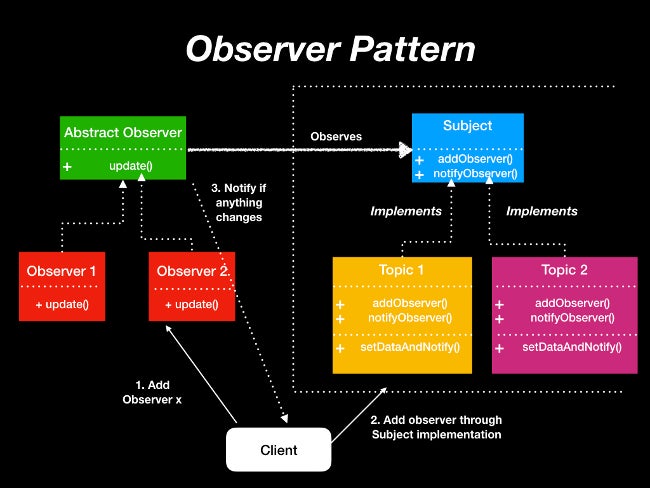
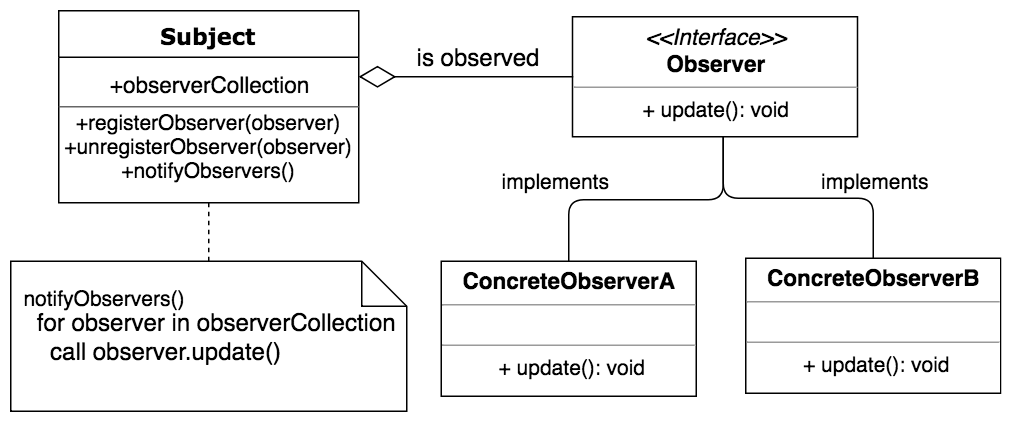
All concrete observers register themselves to be notified for any further update in the state of subject. The Factory pattern is another creational design pattern that provides an interface for creating objects in a superclass, allowing subclasses to determine which class to instantiate. This pattern is useful when you need to decouple the creation of objects from their usage and when you want to create different objects based on some conditions. The subject keeps track of its observers without knowing their concrete types. All it knows is that whenever its state changes, it has to notify all observers by calling their update method to propagate its changes.
Observer pattern in the Spring Framework - Spring 5 Design Patterns [Book] - O'Reilly Media
Observer pattern in the Spring Framework - Spring 5 Design Patterns .
Posted: Sun, 23 Sep 2018 23:15:09 GMT [source]
Disadvantage of Observer Method Design Pattern
In a practical example, a weather app on your smartphone is a concrete observer that reacts to changes from a weather station. The Observer Design Pattern, classified as a behavioral design pattern, enables multiple objects to receive updates when changes occur in another object they are observing. Using the observer pattern is a great way to enforce separation of concerns and the single-responsiblity principle.
Step Wise Implementation of above Problem:
Observer defines an interface with an update method that concrete observers must implement and ensures a common or consistent way for concrete observers to receive updates from the subject. Concrete observers implement this interface, allowing them to react to changes in the subject’s state. But the fact that the subject automatically informs all registered observers about any changes is not always an advantage. After all, change information is even sent if it is irrelevant for one of the observers. This can have a negative effect if the number of registered observers is very high, because a huge amount of computing time can be wasted by the observer system in this case.
How technology is reshaping the fashion industry - Nigerian Observer
How technology is reshaping the fashion industry.
Posted: Fri, 09 Feb 2024 08:00:00 GMT [source]
The auctioneer starts thebidding, and "observes" when a paddle is raised to accept the bid. Theacceptance of the bid changes the bid price which is broadcast to allof the bidders in the form of a new bid. Although we can use the observer pattern in many ways, it can be very useful when working with asynchronous, event-based data.
How to Implement
Using the push method, the subject transmits the changed status together with the notification. However, this can result in issues if information is sent which the observer is unable to utilize. With this approach, the subject merely forwards the information that changes have been made.
Creational Software Design Patterns in Java
We could have avoided this call by passing message as argument to update() method. Here is a simple test program to consume our topic implementation. In this implementation, the editor class doesn’t maintain the subscription list by itself. It delegates this job to the special helper object devoted to just that. You could upgrade that object to serve as a centralized event dispatcher, letting any object act as a publisher.
However, if you still need a specific order for a limited number of observers, you could wrap them into a root observer and register only that observer at the subject. This root observer would then forward and orchestrate the update notifications to its children. The best choice may often be something in between these two extremes. A subject could fire different types of updates, and observers can decide for which updates they want to register, e.g. by using some kind of topic during registration. A observer object can register or unregister from subject at any point of time. This is the observer class which is implemented by concrete observer class.
You can't perform that action at this time. You signed in with another tab or window. You signed out in another tab or…
Delegate all "view" functionality to decoupled anddistinct Observer objects. Observers register themselves with theSubject as they are created. Whenever the Subject changes, itbroadcasts to all registered Observers that it has changed, and eachObserver queries the Subject for that subset of the Subject's statethat it is responsible for monitoring. With reactive programming, we can, for instance, interpret any user input as an input stream of interaction data that we translate into domain actions. Applying these actions further to our application state results in a new and derived state, which we then propagate to observers like different UI components.
We can follow the pattern details and implement a solution that suits the realities of your own program. The Mediator eliminates direct connections between components, establishing a single mediator as the hub. Observer allows dynamic subscription and unsubscription of receivers, enabling more flexible relationships between objects. In this section, we’ll implement a simple chatroom application using the Observer pattern. Creates the subject, and observers, attaches observers to the subject, and notifies observers with a message. Declares a method for receiving updates, ensuring conformity among observers.
While recent frameworks and libraries like Angular, React Redux, Flutter Bloc, or even WPF can deal with this problem by design, they often rely on the concepts introduced by the Observer pattern. Hence, understanding how it works also gives us a better understanding of today's technologies, so let's have a deeper look at this pattern. It also shares the best practices, algorithms & solutions and frequently asked interview questions. Build or host a website, launch a server, or store your data and more with our most popular products for less.
So, if design patterns still aren’t part of your development toolbelt, here are five reasons you should add them. In conclusion, the Observer pattern proves instrumental in establishing dynamic subscriptions and notifications between objects in software systems. Enabling flexible and loosely coupled communication, the Observer fosters scalable and responsive applications. Define an object that is the "keeper" of the data model and/or businesslogic (the Subject).
Here is the implementation of Observers that will watch over the subject. Observer Design Pattern is a behavioral design pattern where an object, known as the subject, maintains a list of its dependents, called observers, that are notified of any changes in the subject’s state. This pattern is often used to implement distributed event handling systems. For our observer pattern java program example, we would implement a simple topic and observers can register to this topic.


No comments:
Post a Comment